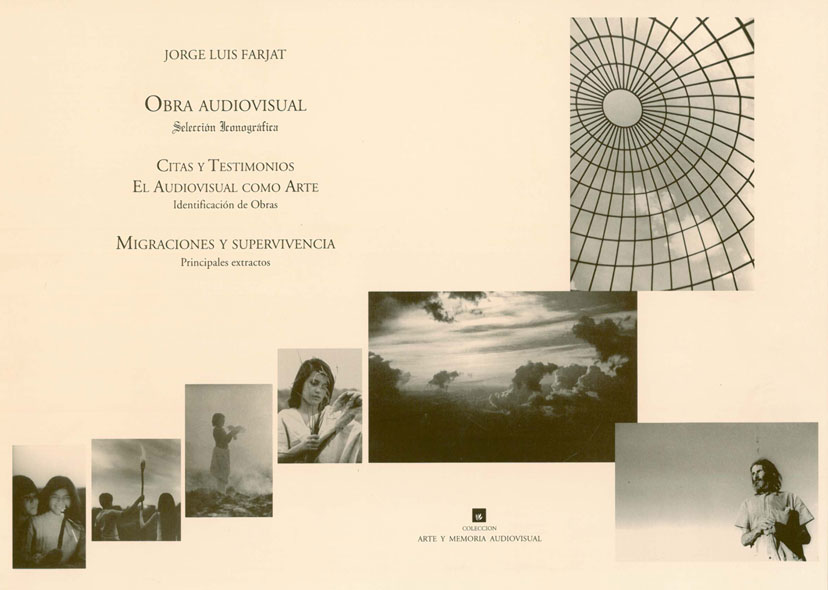
Various works
Migrations and Survival. Main excerpts
Audiovisual Work. Iconographic Selection.
Quotations and testimonials – The Audiovisual as Art.
Identification of the Works
Jorge Luis Farjat

Migrations and Survival. Main excerpts
Audiovisual Work. Iconographic Selection.
Quotations and testimonials – The Audiovisual as Art.
Identification of the Works
Jorge Luis Farjat
Biblioteca Nacional de Maestros. Rincón del Editor.
The first book Audiovisual Work: Iconographic Selection exposes 343 preceded pictures of a foreword in the one which the author -Jorge Luis Farjat – it synthesizes fundamental principles of the audiovisual art and other related with the philosophical suppositions of its work. This in turn agrees with of being to their other book Migrations and Survival. Quotations and testimonials it constitutes an anthology of the literary works of the author accompanied with graphic material of great aesthetic value.
El Entre Ríos
February 12th, 1992
Jorge Luis Farjat is devoted from the 19 years to the creation and production of audiovisuals, essentially artistic, although he alternates in parallel genres such as the scientific documentary one or of institutional promotion. It concludes in 1979 the edition of his book Audiovisualogy. The Audiovisual as art and mean of communication, essentially heading literary rehearsal to describe in analytic form all the original syntheses and unexpected formulas that appear in the language of the static image, fused with the sound, in particular the music. As for his audiovisual ones, it is to highlight the artistic quality that the images assembled with the elements of the music have: rhythm, melody, harmony and counterpoint. The musical fragments of the selected works belong to big classic, romantic and post – romantic composers.
The artist allows to see a great auditory and visual sensibility, making that in the work it is been able to rediscover sounds, objects, colours that daily our eyes and ears perceive almost unconsciously and we don’t give them the true value.
Estrella Sosa de Meichtry
El Entre Ríos
January 15th, 1992.
According to the most authentic Greek etymology, aesthetics is “the characteristic of the sensibility.” And that sensibility achieves in the author to capture an artistic work, being been worth of the audiovisual as an expressive mean. Image and sound are conjugated and they achieve the favourable environment to settle us in a new reality: that of the art, the place of the ineffable. The author, expert and studious of the Audiovisual, he achieves starting from daily topics, the creation of new realities. Or, rather, of unrealities. Real, it is only the first plane, that of the artistic materials. The constitution of a world of unpublished meanings is an unreal one. And this is common to all work of art: to be able to penetrate in a world endowed with new significances where a landscape, a face, a tree, a fragment of that reality that we call world, acquires the possibility to constitute in a new plane the celebration and exaltation of the life. Jorge Luis Farjat met our area, he was interested in the regional history and he felt, without doubts the creative impulse. Images, forms, colours, sounds, give birth to that world of exaltation of the daily thing. The voices of the interviews have the testimonial value of the historical fact. His photographic camera, his robust and sensitive character at the same time, they are not those of a witness that says what he sees, but those of the artist that subjects that vision to an expressed process and he makes arise, for our astonishment, an unpublished world that demands from who contemplates it an attitude of readiness, of receptiveness of the aesthetic message.
Carlos M. Guiot
Música: Jean Sibelius (1865-1957)